HiBy R6 User Manual
Welcome to use HiBy's products
Thank you for purchasing the portable high-definition lossless music player R6, launched by HiBy. In order to make R6 give you a better experience, this article introduces the common functions and operating methods of R6, hoping to help you understand and use R6 more comprehensively.
At the same time, you are also welcome to log in to the official website of HiBy at https://store.hiby.com/ to learn more about HiBy product information and purchase related products.
R6 Product Picture
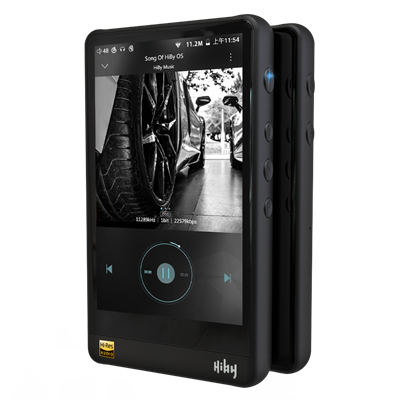
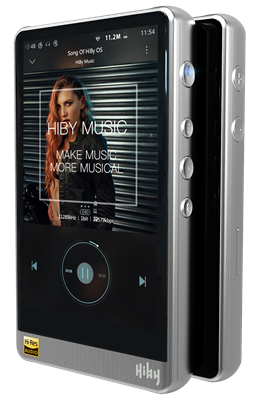
1. Product introduction
- Based on Android 8.1 system, Qualcomm Snapdragon 425 master control, has 3G running memory and 32GB internal storage
- Adopt dual ESS9028Q2M decoding architecture, up to support DSD256 and PCM 384kHz decoding
- Supports PhoneOut(PO), LineOut(LO), Balance analog audio output
- Supports coaxial (S/PDIF) output
- Supports Bluetooth audio output (supports UAT, LDAC, aptX HD, aptX, AAC, SBC, etc. encoding)
- Supports USB audio output
- Supports MQA 8x unfolding
- Supports external MicroSD(TF) cards up to 2TB
- Supports Bluetooth 5.0 and 2.4G and 5G dual-band WiFi
- Supports PD2.0/QC fast charging protocol, maximum support for 15W power charging
- Support local playback, Bluetooth decoding, USB decoding, etc.
The following introduction is the front view of the player screen as reference:
- The top is from left to right: Lo/Coax, PO, BAL
- From top to bottom on the right are: Power button (LED indicator), Previous song, Playback Pause, Next song
- From top to bottom on the left are: volume up, volume down, MicroSD (TF) card slot
- The bottom is: Type-C
2. Button usage instructions
The following introduction is the front view of the player screen as reference:
- From top to bottom on the right are: Power button (LED indicator), Previous song, Playback Pause, Next song
- From top to bottom on the left are: volume up, volume down, MicroSD (TF) card slot
| Button | Function |
|---|---|
| Power button | Long press: power on and off; short press: switch screen |
| Previous song | Short note: Previous song |
| Next song | Short button: Next song |
| Volume Up | Short Press: Increase the volume |
| Volume down | Short press: reduce volume |
| Play Pause | Short button: Play Pause |
| Power button | Long press for more than 10s: Hardware reset |
| Press and hold the volume to turn on the power | Use it to enter recovery mode, see the specific operationRecovery Mode |
In recovery mode, you can not enter the system for clearing and upgrading system data.
- Press and hold the volume to turn on the power, and a robot interface is displayed.
- In this interface, press and hold the power button and press the volume to enter the recovery mode.
- Volume increase and volume decrease are used to make selections, and the power button is used to make sure
3. Interface usage instructions
The following introduction is the front view of the player screen as reference:
- The top is from left to right: Lo/Coax, PO, BAL
- The bottom is: Type-C
Audio output interface
The audio output interface can be provided to different audio devices for use, such as: headphones with 3.5mm interface, headphones with 4.4mm balanced interface, line of 3.5mm interface, balanced input amplifier with 4.4mm interface and other devices.
- PO: 3.5mm single-ended interface headphone output
- LO: 3.5mm single-ended interface line output
- BAL: 4.4mm balanced interface headphone output
Coaxial signal interface
The physical interface used by the coaxial signal interface is the Lo/Coax interface, and the transmitted audio signals adopt the S/PDIF interface protocol. Through this interface, high-standard audio digital signal output can be provided, which can be used through this interface. 【Settings】-》【Audio Settings】-》【Multi-function Output】-》【Spdif】
USB port
The physical interface used by the USB interface is the Type-C interface, through which the following functions can be provided.
The player allows USB to work in two different modes:USB OTGandUSB Device。
When the player asUSB OTGWhen using it (can be understood as USB on the computer):
- Connecting a USB or mobile hard drive: Read data from a USB or mobile hard drive;
- Connect to a USB decoder or USB small tail: output high-definition audio data;
- Connect to a wired network card: access the Internet through a wired network;
Charging interface
The physical interface used by the charging interface is the Type-C interface, through which the charger can be connected to the charger.
- Charging supports PD fast charging protocol. Please use standard PD fast charging head and standard C2C cable for PD fast charging.
- Charging also supports ordinary charging heads, which can reach a charging current of 5V@2A.
MicroSD(TF) card interface
The MicroSD(TF) card interface is used to insert a MicroSD(TF) card, mainly to expand storage capacity. The HiBy player can support MicroSD(TF) cards up to 2TB, and the player supports file systems including FAT32\exFAT\NTFS.
LED Indicator
| Status | Color |
|---|---|
| Normal | Light blue ■ |
| Normal charging | Red breathing effect (normal)■ |
| Fast Charging | Red Breathing Effect (Fast)■ |
| PCM(~48k) | Yellow■ |
| PCM(88.2k~192k) | Cyan■ |
| PCM(352.8k~) | Orange■ |
| DSD | White ■ |
| MQA | Green■ |
| MQA Studio | Blue■ |
| MQA Core (MQB) | Magenta■ |
4. Get started
First boot
- Press and hold the boot key for 2s, and the player enters the boot state The first boot time will be longer.
- After the startup animation is completed, the system enters the boot settings interface
- Select the corresponding language
- Select the corresponding time zone
- Complete the setup
- The first startup is completed
Navigation bar
The system navigation bar is at the bottom of the screen.
- The middle button is Home key: Return to the desktop
- The button on the right is the taskbar key: enter the task list
- The button on the left is the return key: Return Note: Modifying the display size may cause the left and right button function swap of the "Three Buttons" navigation.
Global gestures
- Swipe from the left and right screens to the inside of the screen: Return
- Three fingers slide: screenshot
Main interface
Introduce the relevant functions of the main interface and some common operations. The main interface contains a desktop and an app list. Slide on the desktop to enter the app list.
desktop
-
The status bar is at the top For information descriptions about the status bar, refer to the information descriptions for the status bar later.
-
The desktop icon area in the middle The desktop area can be used to place fast operations
App Icon、Widgetswait Press and hold the blank area of the desktop to pop up the home screen settings, widgets, wallpapers, etc. -
The bottom is a permanent quick operation
App Icon
The main purpose is to place some preset high-frequency application shortcuts here to facilitate users to operate quickly.
Application List
- exist
DesktopSlide up with a single finger to enter the application list - Long press
App IconCan call out the menu - Long press
App IconAnd move, you canApp IconAdd to desktop for quick operation
Status bar
Some information on the status bar.
Status bar left
-
Volume value Display the volume value of the current output port. The volume value in red indicates that the current volume value is too high. Users need to be careful not to use it for a long time at high volume, otherwise it may cause hearing loss. After pulling down the notification bar, clicking the volume value position can trigger the volume control UI, and the current output accent volume can be adjusted under the volume UI.
-
Output port status LineOut PhoneOut Balance
-
Other notification information If the notification information sent by the application used by the user is insufficient in the current position, it may be collapsed in the notification bar. The user needs to pass the status bar position to release the notification bar.
On the right side of the status bar
-
Hide other states Display content: a small dot. It means that there are too many statuses on the status bar, which cannot be displayed in full, and some statuses are hidden.
-
Bluetooth status information Displays Bluetooth information, including signal strength, connection status, etc.
-
WiFi status information Displays WiFi information, including signal strength, connection status, etc.
-
Sampling rate information The displayed content is the final output sample rate information.
-
Battery level information Displays battery icon, charging status, percentage and other information. Power percentage switch: Settings -》 Battery -》 Battery percentage.
5. Play music
Import local music
Import music via USB
The player supports connecting to the computer via USB and then using the MTP protocol to transfer files. Here is a brief introduction. For more information about the use of MTP, please refer toHere 。
The following isMacOSandWindowsMake a brief description:
MacOS requires a third-party driver to be installed before it can be used. Now there are two options:
app
- Open MTP:https://openmtp.ganeshrvel.com/
- Official Android support:https://www.android.com/filetransfer/
Systems after Windows 7 have already included MTP drivers and can be used directly.
You can try it as follows:
- Make sure the USB cable connection is normal
- After confirming that the USB cable is connected, select File Storage in USB in the notification bar;
- Restart the computer and try again
- Restart the player and try again
Import music via MicroSD(TF) card
Insert the MicroSD(TF) card into the player's MicroSD(TF) card slot. The player supports three file formats: FAT32\exFAT\NTFS.
Play local music with HiBy Music
- Open [HiBy Music]
- If you have never scanned a song, it will be displayed as follows. Click [Start Scan] at this time to scan the song and build a song library.
Scan songs
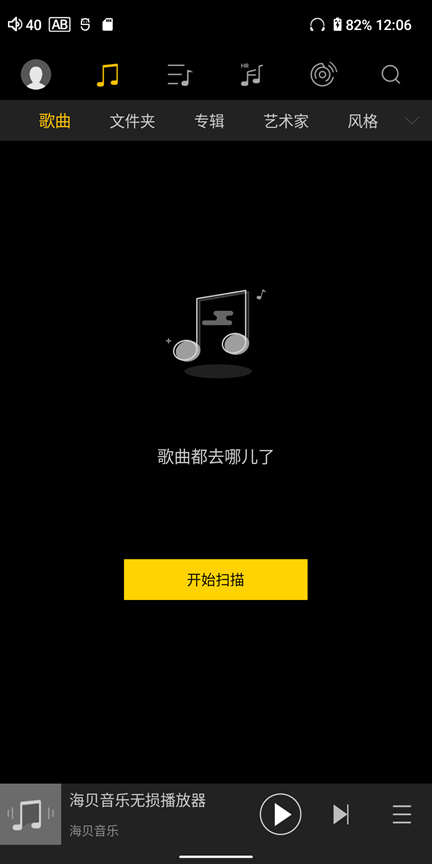
- Just wait for the scan to complete, click the song to play it
For more instructions on using HiBy Music, please refer toHere。
Play streaming music with HiBy Music
- Please make sure you are connected to the network
- Open [HiBy Music]
- Click the [Streaming] icon at the top menu, click again to select different streaming services, such as [Sony Selection] [HiFi Music], and other languages can choose [Tidal] [Qobuz]
Streaming
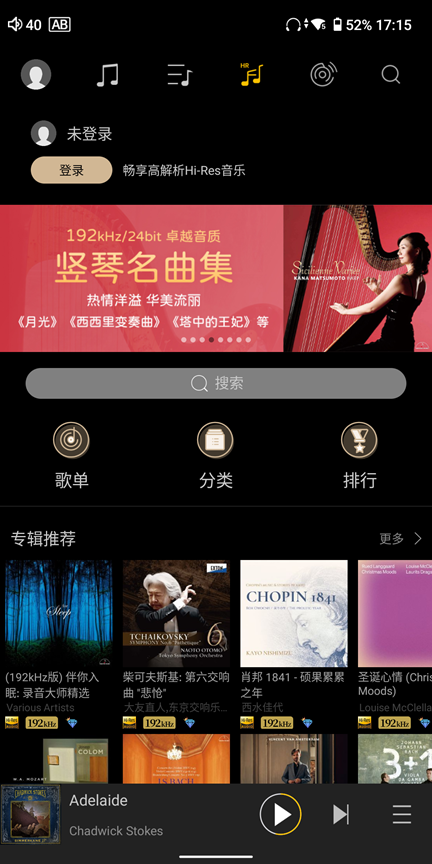
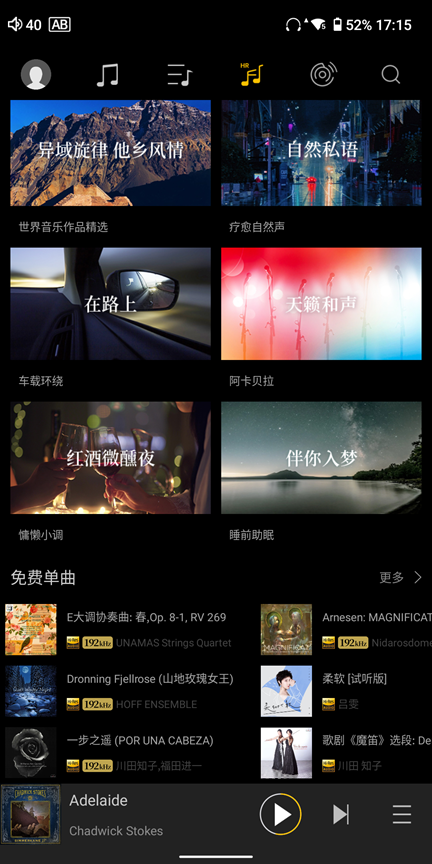
- Choose [Sony Selection], and there are free trial songs at the bottom
Sony Selected Free Songs
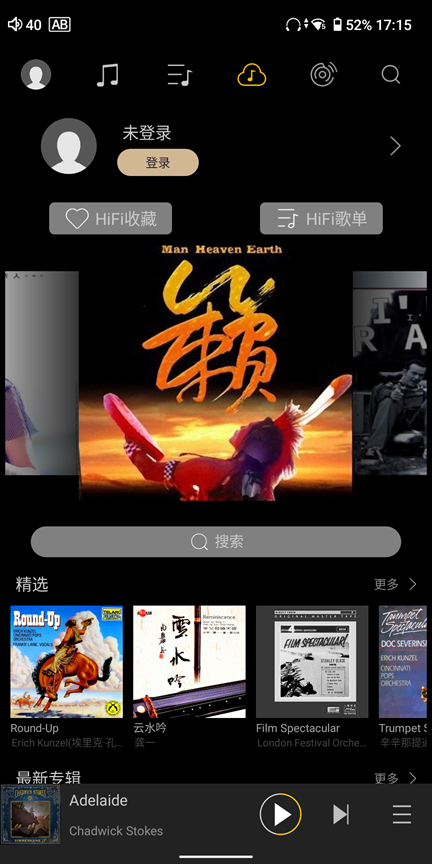
- Select [HiFi Music] and log in to your account. Users can listen to MP3-specific tracks for free
HiFi Music Song
- Select [Tidal] [Qobuz] and you need to log in to the corresponding platform account and then use the corresponding service.
For more instructions on using HiBy Music, please refer toHere。
6. Settings
WiFi settings
Entrance: Settings -> Network and Internet -> WLAN -> Open WLAN -> will automatically scan, and then select the corresponding WiFi network connection.
Bluetooth settings
Entrance: Settings -》 Associated Devices -》 Bluetooth -》 Turn on Bluetooth
USB
Entrance: Settings -》 Associated Devices -》 Default USB Configuration
Battery settings
Entrance: Settings -》 Battery
Used to change the player's battery and power management related settings:
-
Battery percentage Used to switch whether to limit the battery percentage in the notification bar.
-
Idle shutdown After turning on, the device will automatically shut down after the set time has arrived, so as to save power.
Display settings
Entrance: Settings -> Display
Used to change the display related settings of the player:
-
Turn on the power indicator Power indicator switch, used to turn the LED indicators on or off.
-
Turn on the full screen of HiBy Music HiBy Music is used to turn on and off HiBy Music is used to turn on and off.
Lock disk key settings
Entrance: Settings -》 Lock disk key settings
Used to change whether the keys work in the lock disk state:
-
Volume keys Operable Not operational
-
Play/up/down first key Operable Not operational
Audio settings
-
Digital filter mode Selecting different digital filter types can achieve different tones.
-
Multifunction output Select the different outputs of the Lo/Coax interface: Lineout, Spdif.
-
Gain Select different gain modes: the options are Low, Middle, High, and each level is 6dB different.
-
Tone Select different tones: options are default, monitor, warm sound, and bile duct.
-
Plugin Select the sound effects plug-in, and different plug-ins provide a different extended audio processing function.
-
MSEB The sound effect setting function of HiBy provides a more visual description to allow customers to adjust different tones more intuitively.
-
PEQ For more professional sound setting functions for more professional users, more professional sound setting is provided, so that customers can adjust the tone according to their needs more independently on a larger scale.
-
DSD Gain Compensation Since the DSD tracks may have a certain attenuation compared to PCM tracks, you can compensate for the DSD tracks here.
-
Balance Adjust the volume difference between left and right channels. There are some devices with different left and right channels or some users with different left and right hearing. This can be used to adjust it.
-
Maximum volume Limit the maximum adjustable volume range to avoid sudden volume changes caused by misoperation.
7. Preinstalled applications
This introduces some related applications preinstalled by HiBy Player and the functions of these applications. It does not currently support uninstalling preinstalled applications, but some applications support shutdown and running.
-
HiBy Music Player software provided by HiBy, you can view the specific operation instructionsHere。
-
HiByCast Server The local area network same-screen control software provided by HiBy. You can view the specific operation instructions.Here。
【How to turn off the run】Settings -》 Applications -》 HiByCast -
Cool An In the domestic application market with relatively few advertising, you can download the required third-party applications on the market. 【How to turn off the run】Settings -》 Applications -》 Cooan Application Market
-
Google Play Google App Market, you can download the required third-party apps on the market. 【How to turn off the run】Settings -》 Applications -》 Google App Market
-
Via Ultra-lightweight browser, through which you can browse web pages. Similar applications include: Chrome, Edge, etc.;
8. USB DAC mode
USB DAC Mode Guidelines
When the player is working in USB DAC mode, you can think of the player as a USB HD decoding receiver or as a USB sound card. The player works in USB DAC mode supports the USB Audio Class 2.0 (UAC2) protocol, but does not support USB Audio Class 1.0 (UAC1), so the host side also needs to support USB Audio Class 2.0 (UAC2).
- Connect to the host and select [Audio Input (USB Powered)] or [Audio Input (USB Not Powered)] from the drop-down box.
There are certain differences in the support of USB Audio Class 2.0 (UAC2) for different host systems. Please confirm the support according to the corresponding system. Please jump to the details.Here, the following provides a brief reference:
-
Windows Windows (Win7/Win8/Win10 1703 previous version) does not support the USB Audio Class 2.0 (UAC2) protocol, so drivers are required to be installed to use. Please refer to the driver installation.Here。
Windows (Win10 1703 later) begins to support USB Audio Class 2.0 (UAC2) protocol, plug and play. When the computer uses an external power supply, it is recommended to use USB DAC mode (charging). When the computer is powered by a battery, it is recommended to use USB DAC mode (not charged). -
MacOS MacOS itself already comes with a driver, and you can connect the player to the MacOS computer via a USB cable. When the computer uses an external power supply, it is recommended to use USB DAC mode (charging). When the computer is powered by a battery, it is recommended to use USB DAC mode (not charged).
-
Linux distribution Linux's USB DAC support is determined by the kernel. Whether the kernel of different distributions is turned on USB sound card functions is uncertain. For Linux distributions of unsupported USB DACs, you can compile the kernel to implement USB sound card functions by yourself. Or find a third-party app to support USB DAC functionality. When the computer uses an external power supply, it is recommended to use USB DAC mode (charging). When the computer is powered by a battery, it is recommended to use USB DAC mode (not charged).
-
Android The Android side distinguishes between exclusive and non-exclusive methods.
Android non-exclusive Just plug the USB decoder (such as HiBy FC4/HiBy FC6) into the USB port of your phone and use it. If you insert it, you can download HiBy Music and try the exclusive mode of HiBy Music. Otherwise, the phone will not support it. Please contact the mobile phone manufacturer to confirm.
Exclusive Android use Download, install HiByMusic. Enter HiByMusic. Swipe right to open the settings options -> Settings -> Click HiByMusic exclusive USB output, open the exclusive output. Insert the USB decoder (such as HiBy FC4/HiBy FC6) directly into the phone. The phone will pop up "Allow SeaByMusic to access HiBy FC4" and click Allow.
It is recommended to use USB DAC mode (not charged) to save battery power on your phone or tablet.
-
iOS iOS itself already comes with a driver, and you can connect the player to iPhone/iPad via a USB cable. It is recommended to use USB DAC mode (not charged) to save battery power on your phone or tablet.
-
Game console So far, XBOX/PS/Switch and other game consoles only support USB Audio Class 1.0 (UAC1), so the player's USB DAC function cannot be used through the game console.
9. Bluetooth Receive Mode
Bluetooth Receive Mode Guide
When the player is working in Bluetooth reception mode, you can think of the player as a Bluetooth HD decoding receiver or as a Bluetooth headset (after connecting the headset). The player supports decoders such as LDAC/AAC/SBC, so the host side also needs to support encoders such as LDAC/AAC/SBC. Android phones generally support LDAC/AAC/SBC and other encoders, while iPhones only support AAC/SBC encoders for the time being.
- 【Settings】 -》 【Associated Devices】 -》 【Bluetooth】 -》 【Open Bluetooth】 -》 【Bluetooth Audio Input】
- When switching to Bluetooth reception mode, the player will automatically enter the pairing state, and when entering Bluetooth reception mode again, it will automatically connect to the device once;
- Turn on Bluetooth on the mobile phone and connect to the player device you have found;
- Play songs on mobile phone;
- Exit Bluetooth reception mode, enter Bluetooth settings, and delete the Bluetooth pairing of the corresponding phone.
- Enter Bluetooth settings on the mobile phone and delete the Bluetooth pairing of the corresponding player.
10. Frequently Asked Questions
- FAQs can be foundHere